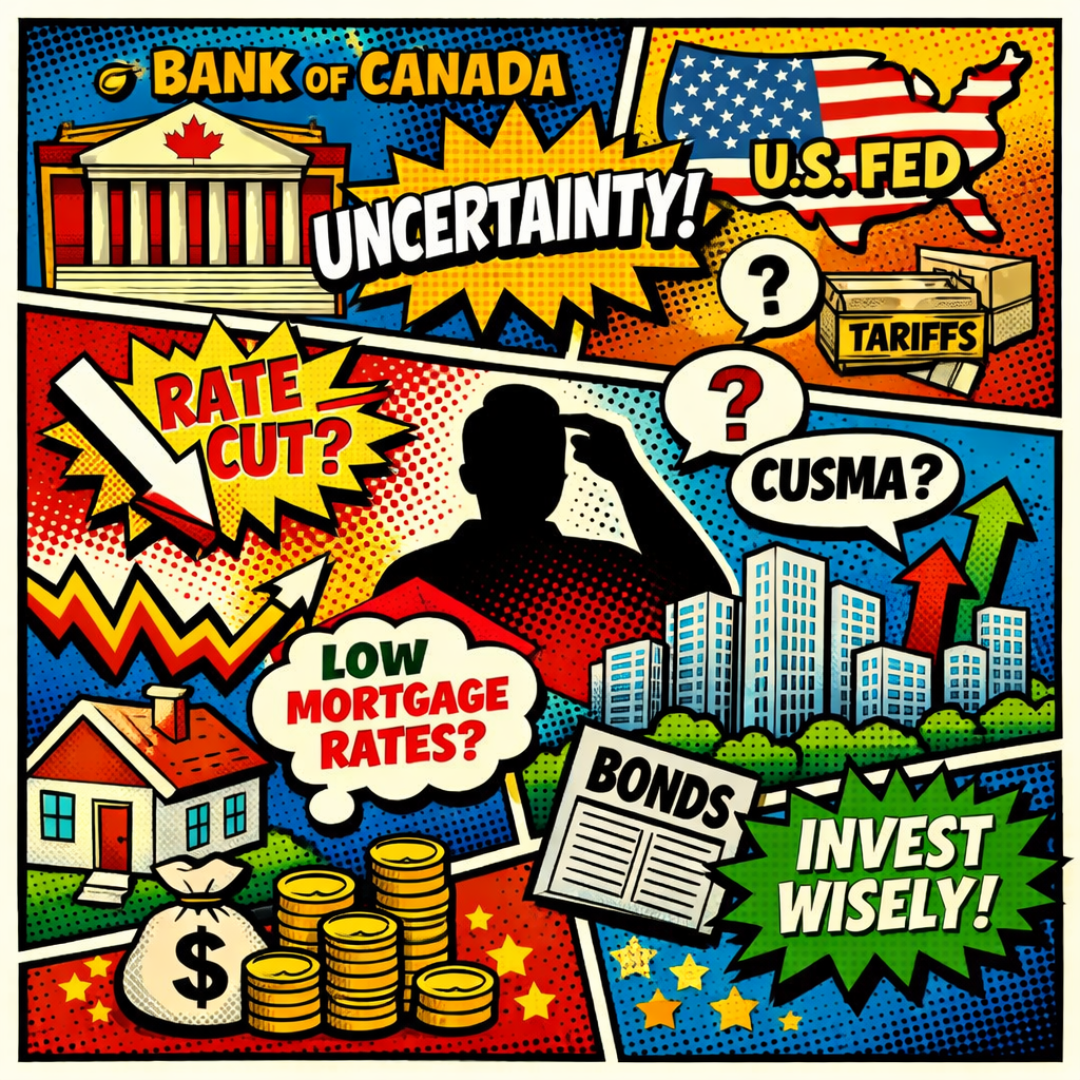
The Bank held — and leaned hard on the word 'uncertainty'
The Bank of Canada held its overnight rate steady last week. No surprise there — the market saw it coming.
What was more interesting? The tone.
The Bank repeated that rates are 'about right' based on its current outlook, and that the numbers around growth and inflation haven't budged much since December. Translation: no urgency to move — for now.
But read between the lines and uncertainty was doing most of the talking.
A lot of the commentary zeroed in on growing global risks, especially trade uncertainty tied to the U.S. That includes unpredictable tariff threats, the upcoming renegotiation of CUSMA later this year, and even concerns around political pressure on the U.S. Federal Reserve and how that could ripple through global markets.
Here's a number: the word 'uncertainty' showed up more than 20 times in the Bank's Monetary Policy Report. Governor Macklem hammered the same theme during his press conference.
The message was clear — the global backdrop is getting murkier, and that limits how confident central banks can be about what comes next.
The Bank also acknowledged something important: it has limited tools to directly help the specific sectors being hit hardest by these risks. That reality helps explain why it's choosing patience over pre-emptive rate cuts right now.
That said, the Bank made a point of saying it's prepared to move quickly if the outlook changes.
Given the emphasis on downside risks, if the next move does come, I still think it's far more likely to be a cut than a hike.
What's happening south of the border
In the U.S., the Federal Reserve also held rates steady.
Unlike Canada, the Fed slightly upgraded its view of the U.S. economy and gave little indication that cuts are on the horizon — despite ongoing political pressure to lower rates.
As one economist neatly put it: the Fed may be under political pressure, but it isn't under economic pressure yet.
What this means for your mortgage
Despite all the noise — tariffs, market swings, political headlines — global bond yields were fairly stable last week.
As a result: Canadian fixed mortgage rates stayed range-bound, and variable-rate discounts were unchanged.
Bond markets are now pricing in a longer pause from the Bank of Canada in 2026. Interestingly, many investors are betting the next move could be a hike.
I'm not in that camp.
I still expect at least one more 0.25 per cent cut at some point this year, especially given how clearly the Bank emphasized its willingness to react if conditions deteriorate.
Insider strategy: making your mortgage interest tax-deductible
There is a way to make mortgage interest tax-deductible in Canada — but it's not a quick win.
It requires patience, discipline, and in some cases significant investment capital. When done properly, though, it can create meaningful long-term savings.
It's not for everyone, but it is worth understanding if you're focused on wealth-building rather than just rate-shopping.
To learn how this all works, check out part one and part two.
My take right now
My advice hasn't changed.
Fixed rates are sitting close to long-term averages, and three- and five-year fixed terms remain the most popular options.
The cost to 'buy extra years' on a fixed rate has been creeping up, and I expect that trend to continue. Right now, five-year fixed terms still offer slightly better value.
Variable rates, in my view, still have the potential to deliver the lowest overall borrowing cost over a full term — even if near-term rate cuts aren't guaranteed.
That said, variable rates are not a set-and-forget choice.
If you're considering one, you need comfort with short-term volatility and the financial capacity to handle higher payments if rates move the wrong way.
Strategy matters more than headlines — and more than the rate alone.