Mortgage Solutions · Strathmore

Refinancing Your Mortgage in StrathmoreWhat It Is, What It Costs, and When It's Worth It

A refinance rewrites your mortgage—new amount, new term, often a new lender—so your home's equity can do something useful: wipe out expensive debt, fund a renovation, buy the next property or simply land you a better rate. The whole game is whether the savings outrun the penalty. We run that math first, for free.

Free conversation. Clear answers. Zero mortgage-speak.
Refinance your mortgage in Alberta — unlock your home equity

Your house has been quietly building equity while you were busy living in it. A refinance is how you put that equity to work—and it's one of the most misunderstood moves in Canadian mortgages. Some people think it's free money. Others think it's a trap. It's neither. It's a math problem, and we're good at math.

Here's the honest version: refinancing your mortgage in Alberta makes a lot of sense in some situations and no sense at all in others. Rolling $40,000 of 20% credit-card debt into a mortgage rate? Usually brilliant. Breaking a fixed mortgage with a five-figure penalty to save a quarter-point? Usually not. Our job is to tell you which side of that line you're on before you commit to anything—and to say so plainly, even when the answer is "don't."

Below is everything we'd walk you through on a first call: what a refinance actually is, the five reasons Albertans do it, how the penalty math works, and what the process looks like from your kitchen table. No mortgage-speak. Promise.

What's the Deal?

What a Refinance Actually Is

A refinance replaces your current mortgage with a brand-new one. That's different from a renewal (same balance, new term) or a switch (same balance, new lender). With a refinance, at least one of three things changes: the amount you owe, the length of your amortization, or both—and you often move to a new lender at the same time. Because it's a new mortgage, the lender looks at everything fresh: your income, your credit, and an appraisal of the home.

01

The 80% Rule

In Canada you can refinance up to 80% of your home's appraised value. Own a $500,000 home with $300,000 left on the mortgage? You could borrow up to $400,000 in total—meaning up to $100,000 of accessible equity. The appraisal decides the number, not the price you paid or what your neighbour's house sold for.

  • Alberta appraisals: usually $300–$450, and you'll typically pay for it up front.
  • What counts against the 80%: your current mortgage plus any HELOC or second mortgage secured against the home.
  • HELOC wrinkle: the revolving (line of credit) portion is capped at 65% of value; the total still can't pass 80%.
02

Why Refinance Rates Sit a Notch Higher

A refinance can't carry mortgage default insurance, so the lender holds all of the risk and prices for it. That puts you on the "conventional" shelf—usually a few tenths of a percent above the insured rates you'll see advertised for first-time buyers. It's still a fraction of the rate on the credit card, car loan or line of credit most people are refinancing to get rid of.

  • Stress test still applies: you qualify at the higher of 5.25% or your contract rate plus 2%.
  • Amortization: most lenders let you reset to 25 or even 30 years, which is how a refinance can add debt and lower your payment at the same time.
  • Your rate is a market rate: see today's live refinance rates before you accept whatever your current lender offers.
The comments · refinance edition

Refinancing has a reputation. Let's check the comments.

Three things people say about refinancing, and what actually happens when you run the math.

11:50100

hellomortgage.ca Refinancing isn't resetting the clock ⏰ It's picking a better clock. Wh…

Comments

  1. back.to.square.one8h

    You're just starting your mortgage over from zero.

    Reply
    hellomortgage.ca8h · Author

    @back.to.square.one Your balance didn't get the memo. It's the same number. Your balance doesn't reset—you owe what you owe. What changes is the rate, the term and, if you choose, the amortization. Many people refinance to a shorter schedule, not a longer one. The 'starting over' feeling comes from the paperwork, not the math.

    Reply
    condo.curious8h

    @hellomortgage.ca 🙌 this makes so much more sense

  2. penalty.panic6h

    The penalty wipes out any savings. Pointless.

    Reply
    hellomortgage.ca6h · Author

    @penalty.panic Sometimes. That's what calculators are for. A variable-rate penalty is usually three months' interest; a fixed-rate penalty can be that or the interest rate differential, which varies wildly by lender. We put the penalty on one side and the savings, the debt you're clearing and the time you'll actually stay on the other. If it doesn't win, we say so. If it does, it usually isn't close.

    Reply
    sarah.saves6h

    @hellomortgage.ca 👏👏 'we say so'

    reno.mike6h

    @hellomortgage.ca 🔥

  3. only.if.desperate4h

    Only people in trouble refinance.

    Reply
    hellomortgage.ca4h · Author

    @only.if.desperate People in great shape refinance constantly. They just don't post about it. Refinancing is how homeowners fund a renovation at mortgage rates instead of line-of-credit rates, clear 20%-interest debt with 5%-interest money, or pull equity for an investment while keeping payments comfortable. It's a strategy tool. Trouble is just the version that makes the news.

    Reply
    kp.northside4h

    @hellomortgage.ca 👏👏👏

  4. hellomortgage.caPinned · Author

    Curious what a refinance would do for your monthly? Tell us the balance, the rate and what you'd want the money for. We'll run both sides of the math for free.

    Reply
Ask us if refinancing makes sense for you…Post
Show Me The Money!

Five Reasons Albertans Refinance

Every refinance we do starts with a "what's the money for?" conversation—because the reason shapes the structure. These are the five we see most, roughly in order of how often they pay off.

Hello Mortgage
hellomortgage.caFive Reasons Albertans Refinance
1/6
#ShowMeTheMoney
01

Consolidate High-Interest Debt

The most common refinance in Alberta, and usually the most obviously worth it. Rolling credit cards, a car loan and a line of credit into your mortgage turns four payments into one and swaps 20% interest for a mortgage rate.

  • The math: $40,000 of card debt at 20% costs about $8,000 a year in interest alone. The same $40,000 at a mortgage rate costs a fraction of that.
  • The honest part: the plan only works if the cards stay empty afterwards. We'll say that out loud.
hellomortgage.ca01 / 06
#ShowMeTheMoney
02

Renovate or Build

A new kitchen, a legal basement suite, a garage—if the work adds value or income to the home, equity is often the cheapest way to fund it.

  • One-time project: a refinance with a lump sum works well.
  • Phased work: a HELOC alongside your mortgage lets you draw as invoices arrive and pay interest only on what you've used.
hellomortgage.ca02 / 06
#ShowMeTheMoney
03

Buy the Next Property

Your equity can be the down payment on a rental, a cabin or a home for a kid heading to university. The refinanced mortgage on your home covers the down payment; a second mortgage covers the rest.

  • Rental income counts: most lenders use 50–80% of expected rent toward qualifying.
  • Plan both mortgages together: the order and structure change what you qualify for.
hellomortgage.ca03 / 06
#ShowMeTheMoney
04

Separation, Divorce or a Buyout

When one person keeps the house, a refinance is how the other person gets paid out. In a separation you can actually refinance up to 95% of the home's value under insured "spousal buyout" rules—one of the few exceptions to the 80% ceiling.

  • What you'll need: a separation agreement and an appraisal.
  • We've done a lot of these: we know how to keep it calm and quick.
hellomortgage.ca04 / 06
#ShowMeTheMoney
05

A Better Rate or a Different Structure

Sometimes the reason is simpler: your rate is well above today's market, or you want out of a variable and into a fixed (or vice versa). This is the reason that most often doesn't pay off once the penalty is counted—so it's the one we scrutinize hardest.

  • Ask first: your current lender may offer a "blend and extend" with no penalty at all.
  • Rule of thumb: the rate gap needs to be big enough to recover the penalty in under two years, or you're just paying to feel better.
hellomortgage.ca05 / 06
#ShowMeTheMoney
That's all.

Still with us?Let's talk.

You now know more than most people do when they sign with their bank.

Knowing is half the win. The other half is a 15-minute call where we turn it into your plan. Let's go get the W.

Let's Get This Going
hellomortgage.ca06 / 06

hellomortgage.ca Swipe through all 5. Then tap the heart if this made it feel less scary.

Do The Math

Penalty vs. Savings: Doing the Math

This is the chapter that separates a good refinance from an expensive one. Every refinance has costs. The question is whether the savings recover them fast enough—and we won't let you sign until you've seen the number.

01

Your Prepayment Penalty

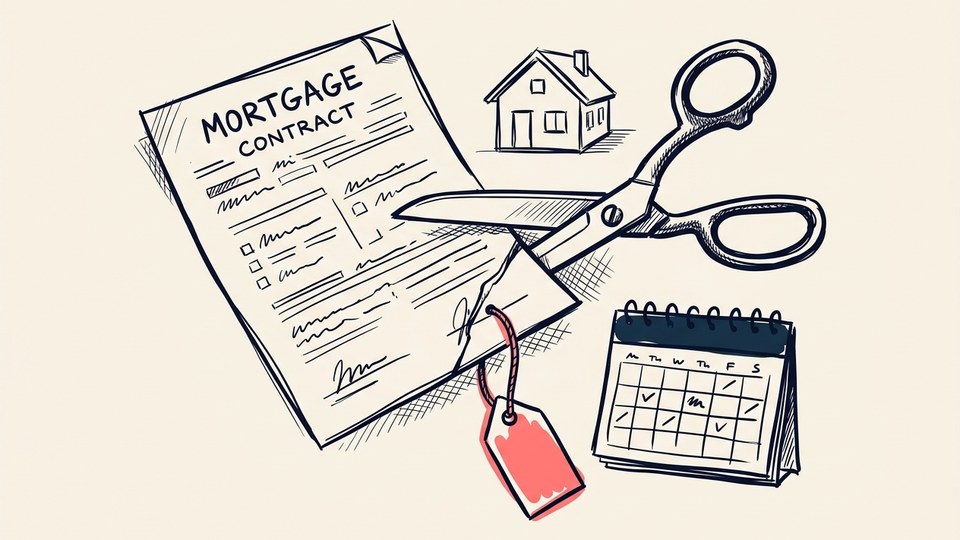
Breaking a mortgage mid-term triggers a penalty, and how it's calculated depends on what you have.

  • Variable rate: almost always three months' interest. On a $350,000 balance at 5%, that's roughly $4,400.
  • Fixed rate: the greater of three months' interest or the Interest Rate Differential (IRD). IRD compares your rate to what the lender could get today for your remaining term—and the big banks calculate it off their posted rates, which can push it into five figures.
  • At renewal: no penalty at all. If your maturity is within six months, waiting can save you thousands—and we can hold a rate 120 days out.
02

The Other Costs

Smaller, but they add up, and you should know them before you start.

  • Appraisal: $300–$450.
  • Legal fees: usually $800–$1,500 in Alberta; some lenders cover them or offer cash back to offset.
  • Discharge fee: a few hundred dollars from the lender you're leaving.
  • Good news: Alberta has no land transfer tax, so there's nothing extra to pay for re-registering the mortgage beyond Land Titles fees.
03

Three Ways to Get There

A full refinance isn't the only tool. Depending on the numbers, one of these may be smarter.

Our refinance calculator shows the break-even month on your numbers. If it says "never," we'll tell you that too.

  • Full refinance: new lender, new amount, new term. Best when the rate gap is wide or you need a large lump sum.
  • Blend and extend: stay with your lender, blend your old rate with today's and add the new money. No penalty, but the blended rate is rarely their sharpest.
  • HELOC or second mortgage: leave your first mortgage alone and add a line of credit behind it. Best when your current rate is great and the penalty isn't.
Let's Get Ready To Rumble

How a Refinance Works, Start to Finish

Most refinances in Alberta fund within two to three weeks of a first conversation, and the paperwork is lighter than your original purchase. We're paid by the lender on almost every refinance, so the advice costs you nothing—and if your file ever needs a lender that charges a fee, you'll hear the exact number before you decide anything. Here's the whole thing.

01

The Process, Step by Step

  1. The Conversation:Tell us what the money's for and send a recent mortgage statement. We pull your penalty, check the equity and run the break-even math—usually the same day.
  2. The Plan:You get a plain-English recommendation: full refinance, blend and extend, HELOC, or "wait for your renewal." With numbers.
  3. Approval:We submit to the lender that fits. Income documents, a credit check and an appraisal order. Approval typically comes back in 2–5 business days.
  4. Signing:You meet with a real estate lawyer (many do this by video), sign the new mortgage, and the old one is paid out.
  5. Funding:The new lender pays off your old mortgage and any debts you're consolidating, and the remaining cash lands in your account. One payment, one rate, one plan.
02

What We'll Ask You For

Have these handy and the whole thing moves quickly.

  • Your current mortgage statement (balance, rate, maturity date and lender).
  • Income proof: recent pay stubs and last year's T4 or Notice of Assessment; two years of returns if you're self-employed.
  • Property details: tax bill and a rough idea of what the home is worth (the appraisal makes it official).
  • The debts you're paying off, if any—statements with balances and account numbers so the lawyer can pay them directly.
How it works

We turn “what now?” into “we’ve got this.”

A clear process, real underwriting upfront and a team that keeps things moving.

Talk to real humans.Who come with a plan.

Tell us what you’re trying to do. We’ll ask the right questions, explain what matters and map out the smartest way forward.

Send the paperwork.We do the mortgage math.

Our team reviews everything upfront. Because surprises are fun at birthday parties—not during financing.

Mortgage approved.We keep it moving.

We manage the lenders, conditions and deadlines while keeping you updated when it actually matters.

Straight from Google

Our clients say it better.

Hello Mortgage Team has over 140 ★★★★★ reviews!

Read our reviews on Google

We refinanced to pay off some debts, and Matt made sure we got the best deal possible. He truly had our best interests in mind!

★★★★★— Derek M. & Lisa J.Alberta1 / 145
Refinance questions · Strathmore

The questions you’re asking. And the ones you should be.

Up to 80% of your home's appraised value, minus what you still owe. On a $500,000 Strathmore home with a $300,000 mortgage, that's up to $100,000 of accessible equity. The appraisal sets the value—not your purchase price or an online estimate—so we often order it early to know the real number.
A renewal keeps your balance and lender and just sets a new term. A switch moves the same balance to a new lender, usually at renewal with no penalty and the new lender covering legal costs. A refinance changes the mortgage itself—more money, a longer amortization, or both—so it needs a fresh approval, an appraisal and, if you're mid-term, a penalty.
Variable: three months' interest, almost always. Fixed: the greater of three months' interest or the Interest Rate Differential (IRD), which varies wildly by lender—big banks calculate it off posted rates and it can run into five figures, while many monoline lenders use a fairer formula. Send us your mortgage statement and we'll calculate yours before you commit to anything.
Slightly. A refinance can't carry default insurance, so it's priced on the conventional shelf—usually a few tenths of a percent above insured first-time-buyer rates. It's still a fraction of the rate on the credit cards or car loan most people refinance to pay off, and we shop it across dozens of lenders rather than taking your bank's first number.
That's the most common refinance we do in Strathmore. Rolling 20% debt into a mortgage rate cuts the interest dramatically and turns four payments into one. The lawyer pays the debts directly at funding so they're actually closed. The discipline part is not refilling the cards—we'll be honest with you about that too.
Yes. Because a refinance is uninsured, you qualify at the higher of 5.25% or your contract rate plus 2%, at every bank and federally regulated lender. Since late 2024 the stress test no longer applies to a straight switch at renewal—but it still applies the moment you add money or extend the amortization. Our calculators build it in so the number you see is the number a lender will see.
If your current rate is great and the penalty is ugly, a HELOC behind your existing mortgage often wins: you leave the first mortgage alone and draw only what you need, up to 65% of value on the revolving portion (80% combined). If the rate gap is wide or you want one predictable payment, a full refinance usually wins. We run both side by side.
Your current lender blends your existing rate with today's rate for the new money and extends the term—no penalty. It's convenient and sometimes the right call, but the blended rate is rarely their sharpest and you're locked in with the same lender. We compare it against a clean refinance so you can see exactly what the convenience costs.
Yes, and this is one of the few exceptions to the 80% rule: under insured spousal buyout guidelines you can refinance up to 95% of the home's value so one person can keep the house and pay out the other. You'll need a separation agreement and an appraisal. We've handled many of these and know how to keep it calm and quick.
It can, and that's often the point. Many people refinance back to 25 or 30 years to lower the payment; others keep the original schedule to stay on track. Both are legitimate—it depends on whether monthly cash flow or total interest is the priority right now. We show you both versions.
Two to three weeks is typical: same-day penalty and break-even math, 2–5 business days for lender approval once your documents are in, an appraisal visit, then a signing with a real estate lawyer (many do it by video). Funding follows within a few days of signing, and consolidated debts are paid out directly by the lawyer.
On almost every refinance the lender pays our fee, so our advice and the comparison shopping cost you nothing. If your situation needs a lender that charges a brokerage fee—usually a credit or income story a bank won't touch—we tell you the exact amount and why before you decide anything.

Let’s make your mortgage make sense.

Ready to apply—or still figuring out what’s possible? Start with a conversation. No pressure. No mortgage-speak. Just a clear plan.

Let’s Talk Mortgage
Explore Strathmore mortgages

Your Strathmore mortgage questions live here.

Find mortgage help across the Strathmore area, then explore the local buying, renewal, refinancing and specialty mortgage pages that match your plans.