Most requested
5-Year FixedSteady
4.34%
Top Canadian Specialty Lender · Hello Mortgage Negotiated · Below Posted
- Monthly payment
- $2,723/mo
Shopping for a mortgage in Leduc can feel like aiming at a moving target. Rates shift daily, every lender prices a little differently, and your down payment, your credit and the property itself all change the number you actually qualify for. That's where strategy earns its keep.
We don't chase the lowest number for its own sake. We compare 50+ banks and lenders, then pair the right rate with the right term and fine print, so the mortgage still fits when life changes. Below: the current mortgage rates in Leduc, updated every business day, what they cost on a Leduc home, and the local questions we hear most.
Tell us and we'll show you the rates you'd actually qualify for—no credit check, about 60 seconds, zero mortgage-speak.
Buying or renewing in Leduc? These are today's rates, straight from the rate desks—not last week's flyer. Payments are on a $500,000 mortgage over 25 years, so it's apples to apples.
Our crystal ball is mostly spreadsheets. Every morning, we read the bond yields, the lender rate sheets and the analyst emails, then write down what we think—and post it publicly, so you can check our work. Here's today's prediction, in two cards.

The rate is the headline. The fine print—where the rate comes from, what it costs to leave, what happens if life changes—is what actually decides which corner a Leduc buyer should be in.
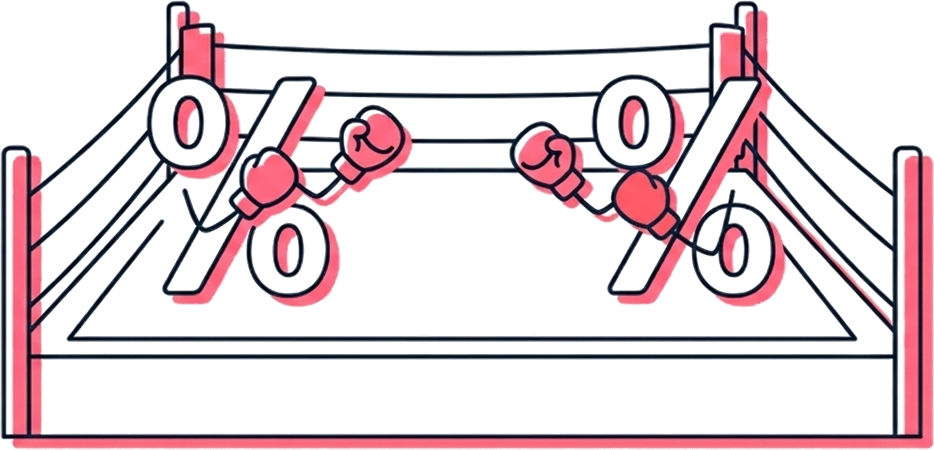
Our take: most people compare the two rates and stop there. The penalty line is where fixed mortgages quietly cost people five figures—and the conversion line is where variable quietly saves them. If there's any chance you'll move, refinance or restructure inside five years, that matters more than a 0.20% gap today.
Leduc sits in a balanced-to-slightly-sellers market right now—Alberta-wide average prices hit $524,545 in August 2026, up about 4% year over year, and supply sits near 3.7 months. For you, that means a detached home averaging around $605,070 provincially will likely push most buyers past the $500,000 insured-mortgage threshold, which matters. Above $500,000 you need at least 10% down on the portion over that amount, and above $1.5 million you'll need a full 20%. Knowing where you land before you start shopping saves real surprises.
Leduc draws a mix of airport and industrial workers, trades, small-business owners, and commuters who value being minutes from Edmonton without paying Edmonton prices. Lenders are comfortable with that employment diversity, but how your income is documented matters enormously. Hourly shift workers, salaried employees, and incorporated contractors all qualify differently. A broker who understands rotating shifts, overtime averaging, and self-employment income can present your situation clearly and get you better options than going straight to a single bank.
In and around Leduc you'll find newer subdivisions, townhomes, semi-detached builds, and acreage properties just outside town. Row homes average around $377,701 Alberta-wide, making them realistic for first-time buyers. Acreages and rural properties often need well and septic inspections and attract fewer lenders, which affects both rate and down payment requirements. Newer builds can come with builder incentives that affect how a lender values the purchase price. Matching the right lender to the right property type is where a good broker earns their keep.
Every mortgage situation is different, but these are the ones we see most often from Leduc buyers
You're renting right now and watching the market. With Alberta-wide row home prices averaging around $377,701 and semi-detached around $520,808, there are entry points here that work with a smaller down payment. Under $500,000 you can go as low as 5% down with mortgage default insurance, which keeps the cash bar lower. Alberta also has no land transfer tax, so your closing costs are lighter than in most other provinces. Getting pre-approved first tells you exactly what you can spend and makes your offer credible in a competitive situation.
You've built equity in your current home and want more space—maybe a larger detached or a property with a garage and yard. The timing puzzle of selling and buying without carrying two mortgages is real. A bridge loan can cover the gap between your purchase closing and your sale closing, but not every lender offers it on the same terms. If your new purchase is over $500,000 you'll need at least 10% on the portion above that threshold, so knowing your net sale proceeds early shapes what you can realistically offer.
If you work shift rotation at Edmonton International or one of the nearby industrial sites, your income might include shift premiums, overtime, or alternating weeks that look uneven on paper. Lenders typically average overtime and shift pay over two years, so having your T4s and recent pay stubs organized matters. A broker will know which lenders treat rotating-shift income most favourably so you're not penalized for how your employer schedules you. Being close to the airport corridor is a genuine advantage for employment stability—lenders recognize that too.
Leduc has a strong trades and contractor community, and if you run your own business or work through a corporation, your taxable income on paper may look very different from what you actually earn. Some lenders use a stated-income or business-for-self program that considers your deposits and business health rather than just your Notice of Assessment. Others want a two-year average of net income after write-offs. Knowing which path fits your situation before you apply means you avoid unnecessary credit pulls and get to a real answer faster.
Properties on the edge of Leduc—acreages, larger lots, or older rural homes—often come with extra lender scrutiny. If there's a well and septic system, some lenders require inspections before they'll approve the mortgage, and the pool of willing lenders shrinks. Smaller acreages with a well-maintained home on them tend to be the easiest to finance. Investment properties require a minimum 20% down payment, which means no default insurance and conventional-only pricing. Having a broker who regularly works with rural and investment purchases in Alberta makes a real difference here.
Mortgage rates aren't one-size-fits-all in Leduc or anywhere else. The number someone brags about at a barbecue came with their down payment, their credit score, their property and their lender's fine print. Yours comes with yours. We replied to every one.

hellomortgage.ca Free mortgage rate advice: available at every barbecue, every long weeke…

@your.uncle 2.79%? We miss her too. Unfortunately, nostalgia isn't an approved mortgage strategy. Your rate is from the day you signed—not today. Rates move with bond yields and the Bank of Canada, sometimes inside a week, so the number from your spring isn't on the shelf anymore. What is on the shelf: a free 120-day rate hold. Lock today's price, shop in peace, and if rates drop before closing you get the lower one. It's the closest thing to 2.79% we can legally offer.
Reply@hellomortgage.ca 🔥🔥🔥 "legally offer"
@hellomortgage.ca 👏👏 tell him
@your.uncle That would make sense. Unfortunately, Canadian mortgages have never let common sense get in the way of a good plot twist. Under 20% down the mortgage is insured, so the lender's risk is covered and they price it sharper. Put 20%+ down and you skip the insurance premium, but the rate itself usually runs a touch higher. Neither is 'better'—they're different math, and we run both before anyone picks.
Reply@hellomortgage.ca 🙌 wait WHAT
@your.uncle Lowest rate wins the screenshot. The mortgage strategy wins the next five years. Penalty formulas, prepayment room, portability, whether you can convert—that's where 'no-frills' rates make their money back. A mortgage that's 0.10% cheaper but costs five figures to break isn't cheaper. We read the fine print so the story ends where you want it to.
Reply@hellomortgage.ca 👏👏👏 say it louder
@hellomortgage.ca 🔥 saving this
So what's your number? Two minutes, no credit check. We'll show you the rates that are actually yours—and explain every one. Bring your uncle if you want.
ReplyAsk us what your rate actually is…PostMost lenders hand you a rate and call it a day. We keep watching. Between your approval and your closing day, if your lender's rate drops, we go back and negotiate the lower one for you—automatically, at no cost. It's one of the reasons Leduc clients don't have to time the market to win it.
No credit check. No commitment. Real lender rates—not the ones printed on a bus bench.

A few quick details. No credit check, no commitment, no mortgage-speak.

Matched to your situation from live lender pricing—not a generic average someone typed in last week.
Which rate, which term, and what puts you in the strongest position—explained like a human would.
A rate is just a number until you know what to do with it. These are the guides we'd hand you across the desk, plus the calculators we'd pull up—written by our team, in plain English, with the math showing.
A rate hold locks in your mortgage rate for 60–120 days while you house-hunt. Here's how they work, what they cost, and what happens if rates move.
Read the guide →Strategy Vault · 3 minFixed gives you the same rate for years. Variable starts lower but can move. Here's how to choose based on your plans, timeline, and comfort with change.
Read the guide →Strategy Vault · 5 minVariable rates have climbed so high they now cost more than fixed — a rare twist. Here's how to decide if locking in makes sense for your mortgage.
Read the guide →Strategy Vault · 5 minWith rates higher than your last term, your lender's renewal offer probably isn't your best option. A little shopping could save you real money.
Read the guide →CalculatorWhat today's rate means per month—and how a 0.25% move changes it.
Open the calculator →CalculatorHow much house today's rates actually buy you, before you fall for a listing.
Open the calculator →Hello Mortgage Team has over 150 ★★★★★ reviews!
Read our reviews on GoogleMatt did an awesome job to help us get approved with our mortgage, always there to help us whenever we had questions. We'll definitely recommend him to our family and friends.
★★★★★— AJ & Vanity G.Leduc1 / 146
Let’s make your mortgage make sense.
Want your actual Leduc rate, not the advertised one? Start with a conversation. No pressure. No mortgage-speak. Just a clear plan.
Let’s Talk MortgageYour Leduc mortgage questions live here.
Find mortgage help across the Leduc area, then explore the local buying, renewal, refinancing and specialty mortgage pages that match your plans.