
Mortgage & Wealth Strategies
Say Hello To The Easiest Way To Mortgage
.png)
Beyond The Rate
As expert mortgage brokers, we know building wealth through homeownership and achieving financial freedom is about more than just chasing the lowest rate—it’s about strategy.
We're taking you behind the scenes and giving you the insider tools and powerful strategies to get ahead. If you’re a first-time homebuyer, you’ll find everything you need to secure your first property and start building wealth from day one.
If you’re an existing homeowner, this is where you take control. Maximize the wealth-building potential of your current home with proven strategies for refinancing, leveraging equity, and optimizing your mortgage for bigger opportunities.
Your mortgage is more than a loan—it’s a gateway to long-term financial success.
Our goal is simple: to equip you with the knowledge and tools to make smart, strategic decisions that will transform your financial future.
Let’s get started.
Something Shifted This Week… Here’s What It Means For Rates
April 13, 2026 | Posted by: Matt Broom-Hall
.png)
Alot shifted over the past week, and if you’ve been watching rates or the news, you can probably feel that things aren’t exactly steady right now.
There’s a bit of a push and pull happening in the background — between economic data, inflation, and what’s going on globally — and it’s all starting to show up in the mortgage space.
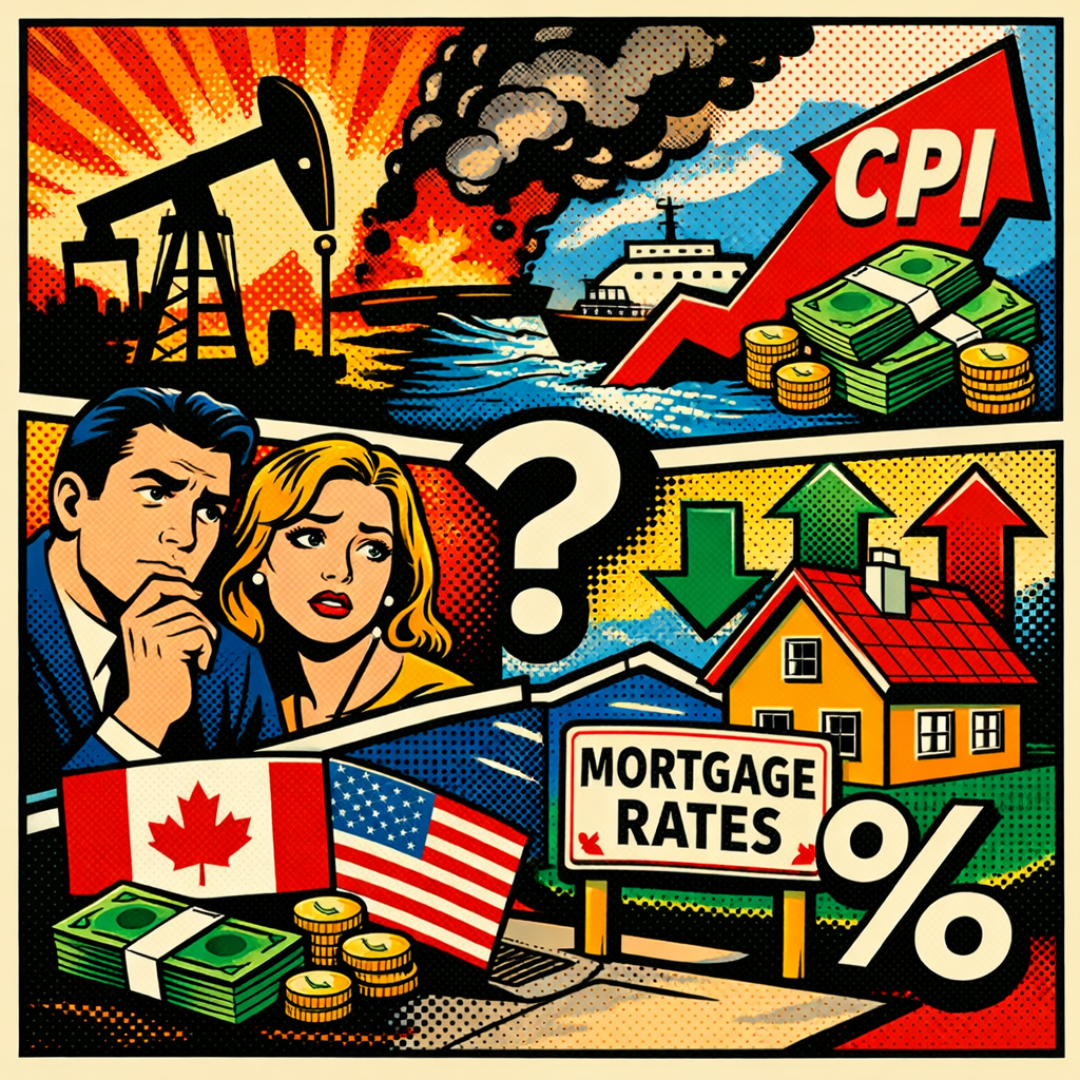
At the same time, consumer confidence dropped to an eleven-month low. That’s being driven by two main concerns — rising energy costs right now, and longer-term uncertainty around global trade.
Then in the US, inflation came in hotter than expected. CPI jumped from 2.4% in February to 3.3% in March, and a big part of that was higher gas prices.
Now, normally central banks will look through a spike like that if it’s temporary. Even Jerome Powell recently pointed out that energy shocks tend to come and go fairly quickly.
The real question is whether those higher energy costs start pushing up prices across the rest of the economy.
So far, we’re not really seeing that. Core inflation — which strips out food and energy — only ticked up slightly from 2.5% to 2.6%.
But here’s where things get more uncertain.
Over the weekend, the US and Iran failed to reach a peace agreement, and the US is now blocking ships leaving Iran from moving through the Strait of Hormuz. That’s a key global shipping route, and Iran has also threatened to restrict other traffic moving through it.
As you’d expect, oil prices have already jumped again because of that.
And the longer this situation drags on, the more time those higher energy costs have to work their way into the broader economy.
Now, even with all of that, this still doesn’t look like a repeat of the inflation spike we saw during COVID.
Back then, people had excess cash, borrowing was cheap, and wage growth was strong. That combination really accelerated inflation.
Today, it’s the opposite.
Borrowing costs are already high, demand is softer, and workers don’t have the same leverage to push wages higher. That actually helps limit how far inflation can spread, even if energy prices stay elevated.
So for now, both the Bank of Canada and the Fed are taking a wait-and-see approach.
What this means for mortgage rates:
Bond yields were pretty volatile last week but ended slightly lower overall. That’s helped fixed rates stabilize for the moment, but I wouldn’t expect a straight line from here. There’s still a lot of uncertainty in the background.
Variable rate discounts didn’t really change.
One interesting shift — the bond market has already started dialing back expectations for future rate hikes. A couple of weeks ago, markets were pricing in about 0.75% in hikes for 2026, and now that’s closer to 0.50%.
That tells you sentiment is already starting to adjust.
My view hasn’t changed — I still think the next move from the Bank of Canada is more likely to be a cut than a hike.
Even with the current energy shock, I expect the longer-term impact of trade changes to be more deflationary.
Where Do We Go From Here?
Fixed rates have been moving up, so if you’re planning to buy in the next 90–120 days, locking in a rate hold right now makes a lot of sense.
Most people are still choosing fixed for the stability, and I completely understand why.
Between 3-year and 5-year fixed, if the pricing is close, I’m generally leaning toward the 5-year for better overall value.
That said, variable rates are starting to look more attractive again from a cost standpoint.
I still believe variable will come out ahead over the full term — but there’s no question it could be a bumpier ride, especially with everything happening globally right now.
And if this conflict drags on long enough and inflation starts to spread more broadly, there could come a point where the Bank of Canada has to tighten again.
I don’t think we’re there — but it’s something to be aware of.
If you’re considering variable, you need to be comfortable with that risk, both mentally and financially.
Insider Tip
Don’t base your decision on what a lender says you can afford. They’re not thinking about your life outside the mortgage — saving, travel, flexibility, all of it.
The better approach is to build your plan around what feels comfortable for you, not the maximum number on paper.
That’s how you stay in control long-term.