
Mortgage & Wealth Strategies
Say Hello To The Easiest Way To Mortgage
.png)
Beyond The Rate
As expert mortgage brokers, we know building wealth through homeownership and achieving financial freedom is about more than just chasing the lowest rate—it’s about strategy.
We're taking you behind the scenes and giving you the insider tools and powerful strategies to get ahead. If you’re a first-time homebuyer, you’ll find everything you need to secure your first property and start building wealth from day one.
If you’re an existing homeowner, this is where you take control. Maximize the wealth-building potential of your current home with proven strategies for refinancing, leveraging equity, and optimizing your mortgage for bigger opportunities.
Your mortgage is more than a loan—it’s a gateway to long-term financial success.
Our goal is simple: to equip you with the knowledge and tools to make smart, strategic decisions that will transform your financial future.
Let’s get started.
What the market showed us (for a few hours)
April 20, 2026 | Posted by: Matt Broom-Hall
.png)
It felt like one of those weeks where things were moving fast, but not necessarily in a straight line.
Headlines were loud, markets were reacting, and underneath it all there were a few moments that gave us a clearer look at what might be coming next.
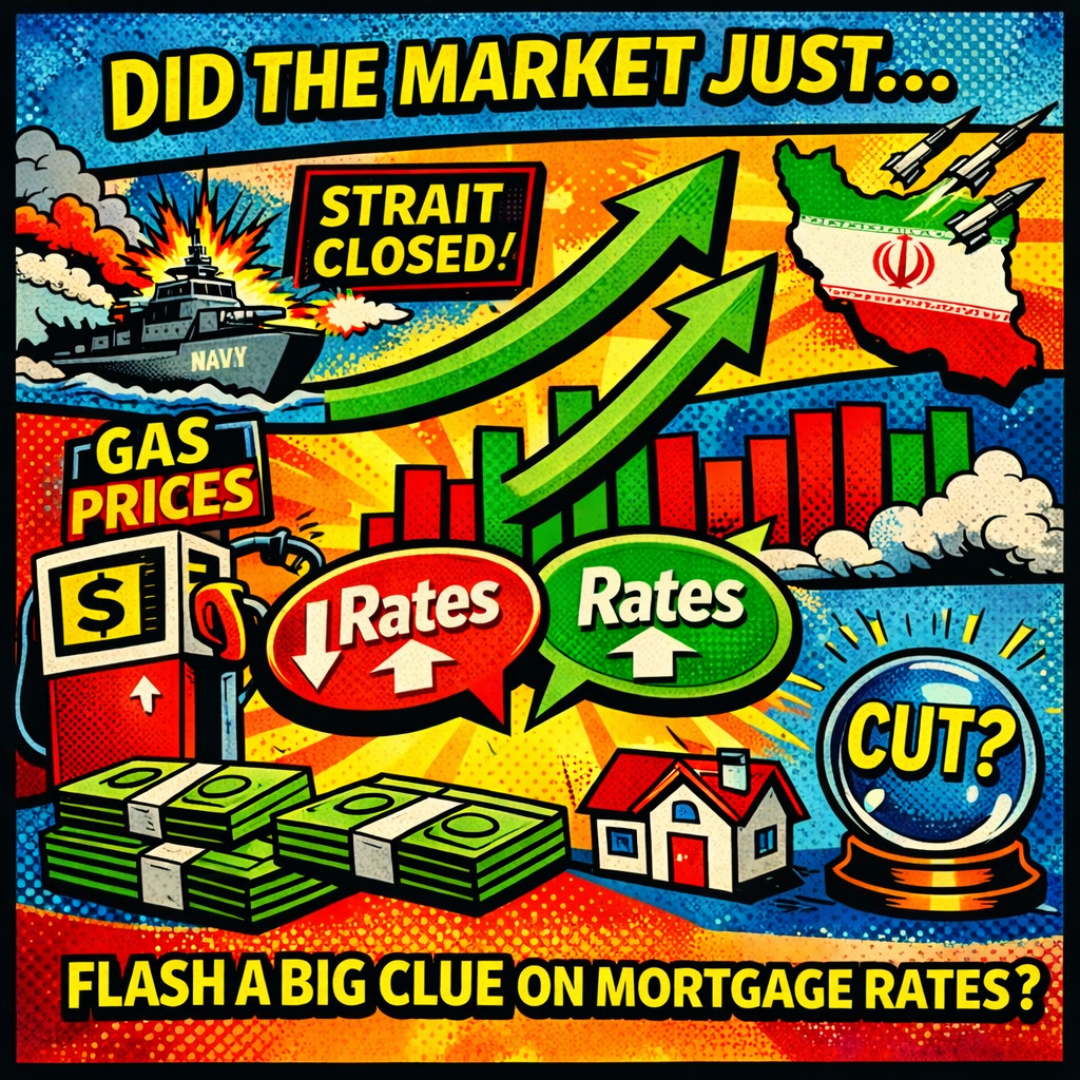
But just as quickly, the situation reversed. A U.S. Navy incident with an Iranian-flagged ship led to the Strait closing again, and we’re right back in a holding pattern where markets are trying to price in uncertainty.
That uncertainty is showing up most clearly in energy. U.S. gas prices jumped 21% in March, which pushed headline inflation up 0.9% month-over-month. On the surface, that sounds concerning. But when you strip out energy and food, core inflation only rose 0.2%, actually coming in lower than expected.
That’s an important distinction.
Because when you look past the oil-driven spikes, the broader inflation picture — especially here in Canada — is still relatively calm. Before this conflict started, most of our key inflation measures were already hovering around the Bank of Canada’s 2% target. Even shelter costs, which have been the main pressure point for years, are starting to cool, with February showing just a 1.5% annualized increase.
At the same time, the Bank of Canada is describing the labour market as weak, consumer confidence has dropped to an eleven-month low, and the parts of the economy that usually react first to interest rates — housing, spending, and business investment — have already slowed down.
So while the risk of higher inflation from rising oil prices is real, the data we’re seeing right now doesn’t show that it’s spreading through the rest of the economy yet.
The latest on rates
Bond yields have been volatile, but they ended last week slightly lower than where they started. Fixed mortgage rates have stabilized for now, but they’re still sensitive to every headline tied to this conflict. Variable-rate discounts haven’t moved much.
A few weeks ago, markets were pricing in as much as 0.75% in rate hikes for 2026. That expectation has now dropped to about 0.25%, and it’s still trending lower.
My take hasn’t changed much here. I still think the bond market is leaning too heavily into worst-case inflation scenarios. There’s a bit of recency bias from the COVID years baked into that thinking. If anything, I believe the longer-term pressure from trade conflicts and slowing growth will outweigh the temporary inflation from energy.
Which is why I still see the Bank of Canada’s next meaningful move eventually being a rate cut — not a hike.
My take on options
Fixed rates are still the go-to for a lot of borrowers right now, and I get it. Stability has value, especially when things feel uncertain. Three- and five-year fixed terms remain the most popular, and if the pricing between them is close, the five-year option continues to offer better overall value in my view.
That said, variable rates are starting to look more attractive again from a cost perspective. The gap between fixed and variable has widened as bond yields pushed fixed rates higher.
Over a full five-year term, I still expect variable rates to come out ahead on total cost.
But there’s a trade-off. The ride could be bumpier than it looked a few months ago. If the conflict drags on and higher oil prices start feeding into broader inflation, the Bank of Canada may have to respond.
Right now, that’s not the base case. But it’s something borrowers need to be comfortable with before choosing a variable option.
This is one of those environments where there isn’t a one-size-fits-all answer. It really comes down to how you balance cost, stability, and your own tolerance for uncertainty.
Insider’s Tip
A lot of people think choosing between fixed and variable is about predicting where rates are going.
It’s not.
It’s about choosing the type of risk you’re more comfortable living with.
Fixed gives you payment certainty but can cost more over time. Variable can save money, but you need to be able to handle the ups and downs without stress.
The right choice isn’t the one that “wins” on paper. It’s the one that still feels manageable no matter how the next 12–24 months play out.